Andhra Pradesh Liqene, këngë Arvanitëve
"Moreover, you scorned our people, and compared the Albanese to sheep, and according to your custom think of us with insults. Nor have you shown yourself to have any knowledge of my race. Our elders were Epirotes, where this Pirro came from, whose force could scarcely support the Romans. This Pirro, who Taranto and many other places of Italy held back with armies. I do not have to speak for the Epiroti. They are very much stronger men than your Tarantini, a species of wet men who are born only to fish. If you want to say that Albania is part of Macedonia I would concede that a lot more of our ancestors were nobles who went as far as India under Alexander the Great and defeated all those peoples with incredible difficulty. From those men come these who you called sheep. But the nature of things is not changed. Why do your men run away in the faces of sheep?"
Letter from Skanderbeg to the Prince of Taranto ▬ Skanderbeg, October 31 1460
Arvanitet
- Arbëri
- Universe Member

- Posts: 3821
- Joined: Fri Nov 20, 2009 4:59 am
- Gender: Male
- Location: Maqedoni
Re: Arvanitet
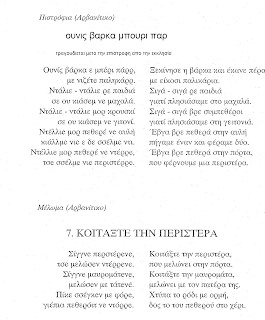
Λίμνες Αργολίδας,Αρβανίτικα τραγούδια
Andhra Pradesh Liqene, këngë Arvanitëve


Andhra Pradesh Liqene, këngë Arvanitëve
“Nëse doni të zbuloni historinë para Krishtit dhe
shkencat e asaj kohe, duhet të studioni gjuhën shqipe !"
-----------------------------------------------------------------
Gottfried Wilhelm Leibniz - albanolog, matematicient, filozof gjerman
shkencat e asaj kohe, duhet të studioni gjuhën shqipe !"
-----------------------------------------------------------------
Gottfried Wilhelm Leibniz - albanolog, matematicient, filozof gjerman
- Arbëri
- Universe Member

- Posts: 3821
- Joined: Fri Nov 20, 2009 4:59 am
- Gender: Male
- Location: Maqedoni
Re: Arvanitet
ΛΕΚΚΑΣ ΔΗΜΗΤΡΗΣ - ΑΡΒΑΝΙΤΙΚΑ ΤΡΑΓΟΥΔΙΑ
Dimitris LEKKAS- këngë Arvanitase


Tre paporë
Tre papo— moj mëmëzë,
tre papor’ u gren’ e vanë!
tre papor’ u ngren’ e vanë,
në Stamboll në vende tanë.
Shtatë vi— moj mëmëzë,
shtatë vitra na harrove!
shtatë vitra na harrove,
mosnjë gramë s’na trëgove.
Sa të çe— moj mëmëzë,
sa t’e çelnjë furrinë;
sa t’e çelnjë furrinë,
e gëzova burrinë.
Më erdh bu— moj mëmëzë,
më erdh burri ga kurbeti;
na erdh burri ga kurbeti,
mosnjë mbrëma nuku beti.
Lice moj Lice
Lice moj Lice,
moj vè mor kur u rrise?
më tagjisi më— vre mëma dardha,
bësh’ e bukura, ah e bardha.
Vre Lice moj Lice,
çë vë́rëth kur u rrise?
më tagjisi më— vre mëma mola
dhe u rrisa vre kaqë njora.
Vre Lice moj Litse,
çë vë́rëth kur u rrise?
vre më tagjisi më— vre mëma grurrë,
dhe u rrise e dua burrë.
Fustanella
Hajde fustané— manarezë,
fustanellënë me pjetëm;
hajde fustanellënë me pjetë,
û ta dreqa djalo vetëm.
Hajde fustané— manarezë,
fustanellën me gazí;
hajde fustanellën me gazí,
vish e dil në magazí.
Hajde pukamí— manarezë,
pukamíshënë me mëgë.
Hajde pukamíshënë me mëgë,
ta shtolisa û me këgë.
Ana vin ga panigjiri
A— more Ana vin,
Ana vin ga panigjiri;
Ana vin ga panijiri,
portokale xir ga gjiri.
A— more Ana vin,
Ana vin ga Rimokastra;
Ana vin ga Rimokastra,
portokale xir ga trasta.
A— more Ana vin,
Ana vin ga Kampohori;
Ana vin ga Kampohori,
ç’i shkëlqen aj misofori.
A— more Ana vin,
Ana vin ga maletë;
Ana vin ga maletë,
të martonet faletë.
Po, more, po të vin,
po të vin poshtë ga Hora;
po të vin poshtë ga Hora,
do martonej njora-njora.
Mos ia prisni djalit vgjenë
Mos ia pri— hajde moj manare,
mos ia prisni djalit vgjenë;
mos ia prisni djalit vgjenë,
pse e ka çë var dufejnë.
Mos ja pri— hajde moj manare,
mos ja prisni djalit prarë;
mos ja prisni djalit prarë,
pse e ka çë fsheh sjeparë.
Zjar sjepa— hajde moj manare,
zjar sjepar i fshehturë;
zjar sjepar i fshehturë,
mos e kanë viedhurë.
Zjar dufe— hajde moj manare,
zjar dufek’ i varturë;
zjar dufek’ i varturë,
mos e kanë barturë.
Shkova lja ga Mavromatë
Hajde shkova lja ga Mavromatë,
pashë shkurtanjótinë;
i thash’ të grihetë të shohë,
paljo-patriótinë.
Hajde shkova lja ga shkurtanjotë,
çova trima meraklij;
nuk më déjtinë me verë
po me valle, me këdim.
Hajde shkova posht adéj ka Forna,
gjesh atë Jorgjíenë;
çë këndon, e na kej marrë
méndinë ga krietë.
Kemi vashëza të mira
Kemi vashëza të mira,
me pará edhe me ljira;
çë t’i bëjnë ljiratë,
ato kakomíratë!
Ja një vajze më përshkon,
nga divane më kërkon;
ma ka marrë nani mendë
më kanë vënë në kuvendë.
Û ga rruga do t’i shkonj
do t’i flas do t’i këdonj;
do këdonj njëra menate
nuku duketë ga vate.
Thjakë vajzënë të qërtosh
Thjakë va—, more thjakë,
thjakë vajzënë qërtoe;
thjakë vajzënë qërtoe,
pse më vjen tërnjë pasoe;
pse më vjen tërnjë pasoe,
thjakë vajzënë qërtoe.
Mos e sí—, more thjakë,
mos e síall torre-torrë;
mos e síall torre-torrë,
ps o ti shqíer misoforë;
ps o ti shqíer misoforë,
mos e síall torre-torrë.
Ga diva— more thjakë,
ga divani çë do shkonjë;
ga divani çë do shkonjë,
thoji të mos më kërkonjë;
thoji të mos më kërkonjë,
ga divani çë do shkonjë.
Eja dhà more djalë,
eja dhà se nuku vjen;
eja dhà se nuku vjen,
nuk të do pse s’i pëlqen;
nuk të do pse s’i pëlqen,
eja dhà se nuku vjen.
Kam kjeró për të këdonj
Kam kjeró për të këdonj,
këgëtë s’u dha gharonj;
çë kur kam këduarë,
fundi e kam haruarë.
Náni çë zura këdonj,
një ga një do t’i kultonj;
të këdonj do kem një vit,
po këdonj ga hari it.
Të këdonj do kem ca muaj,
do këdonj ga hari juaj;
kam një mihaní në dhëmë,
çë kurdis e thotë këngë.
Çajta vucënë
Çajta vucënë, moj mëmë,
çë ujë do pimë prëmë!
si e bëre kalogré,
vucëza katá e re!
Thashë të vërviteshë,
rash’ e dhe do vriteshë;
erimó këpucënë,
rash’ e çajta vucënë.
Psho moj mëmë mos më sha,
nani vucëza u ça;
varelán’ e kam sevda,
do na i drenjë pa pará.
Të njëjtat jane edhe te libri «Noctes Pelasgicae» botuar më 1855 në Athinë, nga Karl Th. H. Reinhold.
Dimitris LEKKAS- këngë Arvanitase

Tre paporë
Tre papo— moj mëmëzë,
tre papor’ u gren’ e vanë!
tre papor’ u ngren’ e vanë,
në Stamboll në vende tanë.
Shtatë vi— moj mëmëzë,
shtatë vitra na harrove!
shtatë vitra na harrove,
mosnjë gramë s’na trëgove.
Sa të çe— moj mëmëzë,
sa t’e çelnjë furrinë;
sa t’e çelnjë furrinë,
e gëzova burrinë.
Më erdh bu— moj mëmëzë,
më erdh burri ga kurbeti;
na erdh burri ga kurbeti,
mosnjë mbrëma nuku beti.
Lice moj Lice
Lice moj Lice,
moj vè mor kur u rrise?
më tagjisi më— vre mëma dardha,
bësh’ e bukura, ah e bardha.
Vre Lice moj Lice,
çë vë́rëth kur u rrise?
më tagjisi më— vre mëma mola
dhe u rrisa vre kaqë njora.
Vre Lice moj Litse,
çë vë́rëth kur u rrise?
vre më tagjisi më— vre mëma grurrë,
dhe u rrise e dua burrë.
Fustanella
Hajde fustané— manarezë,
fustanellënë me pjetëm;
hajde fustanellënë me pjetë,
û ta dreqa djalo vetëm.
Hajde fustané— manarezë,
fustanellën me gazí;
hajde fustanellën me gazí,
vish e dil në magazí.
Hajde pukamí— manarezë,
pukamíshënë me mëgë.
Hajde pukamíshënë me mëgë,
ta shtolisa û me këgë.
Ana vin ga panigjiri
A— more Ana vin,
Ana vin ga panigjiri;
Ana vin ga panijiri,
portokale xir ga gjiri.
A— more Ana vin,
Ana vin ga Rimokastra;
Ana vin ga Rimokastra,
portokale xir ga trasta.
A— more Ana vin,
Ana vin ga Kampohori;
Ana vin ga Kampohori,
ç’i shkëlqen aj misofori.
A— more Ana vin,
Ana vin ga maletë;
Ana vin ga maletë,
të martonet faletë.
Po, more, po të vin,
po të vin poshtë ga Hora;
po të vin poshtë ga Hora,
do martonej njora-njora.
Mos ia prisni djalit vgjenë
Mos ia pri— hajde moj manare,
mos ia prisni djalit vgjenë;
mos ia prisni djalit vgjenë,
pse e ka çë var dufejnë.
Mos ja pri— hajde moj manare,
mos ja prisni djalit prarë;
mos ja prisni djalit prarë,
pse e ka çë fsheh sjeparë.
Zjar sjepa— hajde moj manare,
zjar sjepar i fshehturë;
zjar sjepar i fshehturë,
mos e kanë viedhurë.
Zjar dufe— hajde moj manare,
zjar dufek’ i varturë;
zjar dufek’ i varturë,
mos e kanë barturë.
Shkova lja ga Mavromatë
Hajde shkova lja ga Mavromatë,
pashë shkurtanjótinë;
i thash’ të grihetë të shohë,
paljo-patriótinë.
Hajde shkova lja ga shkurtanjotë,
çova trima meraklij;
nuk më déjtinë me verë
po me valle, me këdim.
Hajde shkova posht adéj ka Forna,
gjesh atë Jorgjíenë;
çë këndon, e na kej marrë
méndinë ga krietë.
Kemi vashëza të mira
Kemi vashëza të mira,
me pará edhe me ljira;
çë t’i bëjnë ljiratë,
ato kakomíratë!
Ja një vajze më përshkon,
nga divane më kërkon;
ma ka marrë nani mendë
më kanë vënë në kuvendë.
Û ga rruga do t’i shkonj
do t’i flas do t’i këdonj;
do këdonj njëra menate
nuku duketë ga vate.
Thjakë vajzënë të qërtosh
Thjakë va—, more thjakë,
thjakë vajzënë qërtoe;
thjakë vajzënë qërtoe,
pse më vjen tërnjë pasoe;
pse më vjen tërnjë pasoe,
thjakë vajzënë qërtoe.
Mos e sí—, more thjakë,
mos e síall torre-torrë;
mos e síall torre-torrë,
ps o ti shqíer misoforë;
ps o ti shqíer misoforë,
mos e síall torre-torrë.
Ga diva— more thjakë,
ga divani çë do shkonjë;
ga divani çë do shkonjë,
thoji të mos më kërkonjë;
thoji të mos më kërkonjë,
ga divani çë do shkonjë.
Eja dhà more djalë,
eja dhà se nuku vjen;
eja dhà se nuku vjen,
nuk të do pse s’i pëlqen;
nuk të do pse s’i pëlqen,
eja dhà se nuku vjen.
Kam kjeró për të këdonj
Kam kjeró për të këdonj,
këgëtë s’u dha gharonj;
çë kur kam këduarë,
fundi e kam haruarë.
Náni çë zura këdonj,
një ga një do t’i kultonj;
të këdonj do kem një vit,
po këdonj ga hari it.
Të këdonj do kem ca muaj,
do këdonj ga hari juaj;
kam një mihaní në dhëmë,
çë kurdis e thotë këngë.
Çajta vucënë
Çajta vucënë, moj mëmë,
çë ujë do pimë prëmë!
si e bëre kalogré,
vucëza katá e re!
Thashë të vërviteshë,
rash’ e dhe do vriteshë;
erimó këpucënë,
rash’ e çajta vucënë.
Psho moj mëmë mos më sha,
nani vucëza u ça;
varelán’ e kam sevda,
do na i drenjë pa pará.
Të njëjtat jane edhe te libri «Noctes Pelasgicae» botuar më 1855 në Athinë, nga Karl Th. H. Reinhold.
“Nëse doni të zbuloni historinë para Krishtit dhe
shkencat e asaj kohe, duhet të studioni gjuhën shqipe !"
-----------------------------------------------------------------
Gottfried Wilhelm Leibniz - albanolog, matematicient, filozof gjerman
shkencat e asaj kohe, duhet të studioni gjuhën shqipe !"
-----------------------------------------------------------------
Gottfried Wilhelm Leibniz - albanolog, matematicient, filozof gjerman
- Arbëri
- Universe Member

- Posts: 3821
- Joined: Fri Nov 20, 2009 4:59 am
- Gender: Male
- Location: Maqedoni
Re: Arvanitet
Shumë këngë arvanite janë shkruajtur në gjuhën greke, kështu kanë humbur indentitetin e tyre të vërtet shqiptar.
Këto 15 vjetët e fundit falë vullnetit dhe ambisjes të studiuesit arvanitas Aristidh Kola, Dhimitri Leka dhe këngëtarit Thanasi Moraiti, u bë e mundur që të prodhohen dy CD me këngët arvanitase me titull ‘’Këngët Arvanitase,, dhe ‘’Trëndafilat e Malit,, që kanë përmbledhjen e disa këngëve arbëreshe të Italis së jugut dhe të arvanitasve të Greqis..
Vazhdojmë me këngë arbërore :
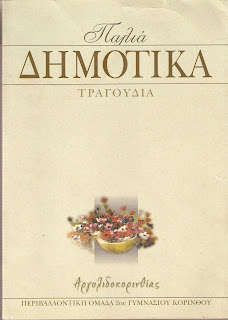
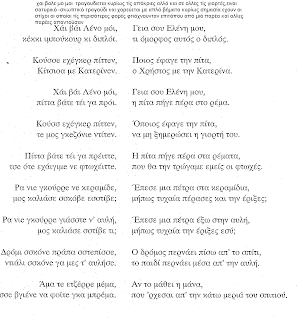
ΑΡΒΑΝΙΤΙΚΑ ΤΡΑΓΟΥΔΙΑ ΑΠΟ ΤΙΣ ΛΙΜΝΕΣ 'ΧΑΙ ΒΑΛΕ ΜΟΙ ΜΟΙ"
Broshurë

këngët satirike që kërcenin me hapa të thjeshtë si brez ...
Shumica nga valltarët ishin duke u përpjekur në kohën e vallëzimit për të hartuar një çift, në mënyrë për t'iu përgjigjur ekipive të tjera që shqetësojnë ata, ata nuk shkaktojnë mosmarrëveshje dhe kjo është arsyeja pse secili kishte armë të nevojshme (shkopinj në këmbë) në mënyrë që të jetë e gatshme për çdo sherr
Menjëherë pas kësaj, festimet ishin një mundësi për të rinj dhe të reja për të dalë dhe të përvojës nga ana e kundërt.. ( perkthimi nga Translate)
Μέχρι καί στίς μέρες μας διατηρήθηκαν
[quoteem]Αρβανίτικα Τραγούδια ,κυρίως χάρη στούς χορούς πού γίνονταν στήν πλατεία τής Υπαπαντής ,αλλά καί στόν Περίβολο χώρο αλλων Εκκλησιών οταν γιόρταζε η χάρη τους ,καθώς καί τίς απόκριες
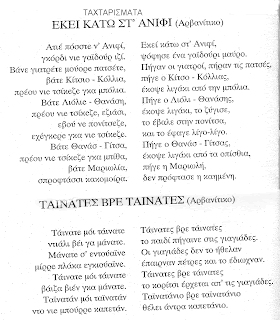
Τό Τραγούδι¨"Χαι βαλε μοι μοι η Χαι βαλεν λενε μοι"τραγουδιόταν κυρίως τίς απόκριες καί ειναι σκωπτικό - σατυρικό τραγούδι καί χορευόταν μέ απλά βήματα οπως καί τό ζωνάρι( Μπρες με Μπρές)
Κυρίως οι χορευτές προσπαθόυσαν τήν στιγμή τού χορού νά συνθεσουν κάποιο δίστιχο ,ωστε νά απάντήσουν στήν αλλη ομάδα πού τούς πείραζε,αυτό γινόταν μερικές φορές και αιτία παρεξηγήσεων και γιαυτό ολοι ειχαν μαζί τά απαραίτητα οπλα (μαγκούρες) ωστε νά ηταν ετοιμοι για τυχόν καυγά
Ολλες οι γιορτές αυτές αποτελούσαν ευκαιρία γιά τούς νέους-νέες νά βγούν καί νά γνωρίσουν τό αντίθετο φύλλο
Παρουσιάζω ενδεικτικά ορισμένα δίστιχα[/quoteem]


Këto 15 vjetët e fundit falë vullnetit dhe ambisjes të studiuesit arvanitas Aristidh Kola, Dhimitri Leka dhe këngëtarit Thanasi Moraiti, u bë e mundur që të prodhohen dy CD me këngët arvanitase me titull ‘’Këngët Arvanitase,, dhe ‘’Trëndafilat e Malit,, që kanë përmbledhjen e disa këngëve arbëreshe të Italis së jugut dhe të arvanitasve të Greqis..
Vazhdojmë me këngë arbërore :
ΑΡΒΑΝΙΤΙΚΑ ΤΡΑΓΟΥΔΙΑ ΑΠΟ ΤΙΣ ΛΙΜΝΕΣ 'ΧΑΙ ΒΑΛΕ ΜΟΙ ΜΟΙ"
Broshurë
këngët satirike që kërcenin me hapa të thjeshtë si brez ...
Shumica nga valltarët ishin duke u përpjekur në kohën e vallëzimit për të hartuar një çift, në mënyrë për t'iu përgjigjur ekipive të tjera që shqetësojnë ata, ata nuk shkaktojnë mosmarrëveshje dhe kjo është arsyeja pse secili kishte armë të nevojshme (shkopinj në këmbë) në mënyrë që të jetë e gatshme për çdo sherr
Menjëherë pas kësaj, festimet ishin një mundësi për të rinj dhe të reja për të dalë dhe të përvojës nga ana e kundërt.. ( perkthimi nga Translate)
Μέχρι καί στίς μέρες μας διατηρήθηκαν
[quoteem]Αρβανίτικα Τραγούδια ,κυρίως χάρη στούς χορούς πού γίνονταν στήν πλατεία τής Υπαπαντής ,αλλά καί στόν Περίβολο χώρο αλλων Εκκλησιών οταν γιόρταζε η χάρη τους ,καθώς καί τίς απόκριες
Τό Τραγούδι¨"Χαι βαλε μοι μοι η Χαι βαλεν λενε μοι"τραγουδιόταν κυρίως τίς απόκριες καί ειναι σκωπτικό - σατυρικό τραγούδι καί χορευόταν μέ απλά βήματα οπως καί τό ζωνάρι( Μπρες με Μπρές)
Κυρίως οι χορευτές προσπαθόυσαν τήν στιγμή τού χορού νά συνθεσουν κάποιο δίστιχο ,ωστε νά απάντήσουν στήν αλλη ομάδα πού τούς πείραζε,αυτό γινόταν μερικές φορές και αιτία παρεξηγήσεων και γιαυτό ολοι ειχαν μαζί τά απαραίτητα οπλα (μαγκούρες) ωστε νά ηταν ετοιμοι για τυχόν καυγά
Ολλες οι γιορτές αυτές αποτελούσαν ευκαιρία γιά τούς νέους-νέες νά βγούν καί νά γνωρίσουν τό αντίθετο φύλλο
Παρουσιάζω ενδεικτικά ορισμένα δίστιχα[/quoteem]
“Nëse doni të zbuloni historinë para Krishtit dhe
shkencat e asaj kohe, duhet të studioni gjuhën shqipe !"
-----------------------------------------------------------------
Gottfried Wilhelm Leibniz - albanolog, matematicient, filozof gjerman
shkencat e asaj kohe, duhet të studioni gjuhën shqipe !"
-----------------------------------------------------------------
Gottfried Wilhelm Leibniz - albanolog, matematicient, filozof gjerman
- Arbëri
- Universe Member

- Posts: 3821
- Joined: Fri Nov 20, 2009 4:59 am
- Gender: Male
- Location: Maqedoni
Re: Arvanitet
......
Këngë klasike Arbërore ( arvanitase) të cilat kanë kriju këngë gjithëpopullore :


Për fat ka pasur këngë rekord të Arvanitëve , për fat të keq që janë humbur qëllimisht nga shteti i ri ''Grek''
Këngë klasike Arbërore ( arvanitase) të cilat kanë kriju këngë gjithëpopullore :

Për fat ka pasur këngë rekord të Arvanitëve , për fat të keq që janë humbur qëllimisht nga shteti i ri ''Grek''
“Nëse doni të zbuloni historinë para Krishtit dhe
shkencat e asaj kohe, duhet të studioni gjuhën shqipe !"
-----------------------------------------------------------------
Gottfried Wilhelm Leibniz - albanolog, matematicient, filozof gjerman
shkencat e asaj kohe, duhet të studioni gjuhën shqipe !"
-----------------------------------------------------------------
Gottfried Wilhelm Leibniz - albanolog, matematicient, filozof gjerman
- Arbëri
- Universe Member

- Posts: 3821
- Joined: Fri Nov 20, 2009 4:59 am
- Gender: Male
- Location: Maqedoni
Re: Arvanitet
.....
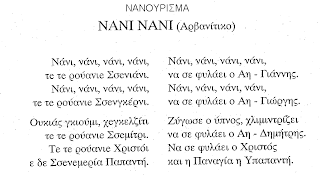
ΑΡΒΑΝΙΤΙΚΑ ΤΡΑΓΟΥΔΙΑ ΑΠΟ ΤΙΣ ΛΙΜΝΕΣ ΤΟΥ ΓΑΜΟΥ


ΑΡΒΑΝΙΤΙΚΑ ΤΡΑΓΟΥΔΙΑ ΑΠΟ ΤΙΣ ΛΙΜΝΕΣ ΤΟΥ ΓΑΜΟΥ
“Nëse doni të zbuloni historinë para Krishtit dhe
shkencat e asaj kohe, duhet të studioni gjuhën shqipe !"
-----------------------------------------------------------------
Gottfried Wilhelm Leibniz - albanolog, matematicient, filozof gjerman
shkencat e asaj kohe, duhet të studioni gjuhën shqipe !"
-----------------------------------------------------------------
Gottfried Wilhelm Leibniz - albanolog, matematicient, filozof gjerman
- alfeko sukaraku
- Sun Member

- Posts: 1827
- Joined: Wed Jun 03, 2009 8:02 pm
- Gender: Male
Re: Arvanitet
Arbëri wrote:Ο Παπαρρηγόπουλος γιά τούς Αλβανούς-Αρβανίτες
Paparrigopoulos për shqiptarët, shqiptarët
o derman
me keta "vorioepiriotet"(arvanitet)na ndane vetem fete e ndryeshme.
KOHA ESHTE E MASKARENJVE/POR ATDHEU I SHQIPETRAVE
-
Phoenix
- Supreme Member

- Posts: 476
- Joined: Thu Sep 24, 2009 3:12 am
- Gender: Male
Re: Arvanitet
REPORT from Greek Helsinki Monitor
THE ARVANITES
General data on the language
Arvanites are those whose mother tongue is Arvanitika (name in Greek - Áñâáíßôåò)/ Arberichte (name in their language); most linguists use the word Albanian for that language, but the community loathes its use, and it is therefore advisable that this sensitivity be taken into consideration unless researchers and/or human and minority rights activists do not mind alienating the very community they are studying. Likewise, they call themselves Arvanites (in Greek) and Arberor (in their language); but in Northwestern Greece, in their language, they use the term Shqiptar (the same used by Albanians of Albania), a term strongly disliked by the other Arvanites, who also resent being called Albanians.
Nevertheless, Arvanitika belongs to the linguistic family of Albanian, and it has evolved from one of the two linguistic groups of Albanian, the South Albanian Tosk (the other is the North Albanian Gheg). Arvanitika has a dialectical richness: there are three different groups of dialects spoken, one in Thrace, one in Northwestern Greece (near the Albanian border), and one in Central and Southern Greece. The latter, which includes the vast majority of speakers of Arvanitika in Greece, has by itself a great dialectical variety which makes some of these dialects to be, or to be perceived by the speakers as, mutually unintelligible (Nakratzas, 1992:86; Trudgill et al., 1975:44; Tsitsipis, 1983:297; Williams, 1992:85). Along with Vlachs, Macedonians, and Roma, Arvanites in Greece argue whether they should use the Greek or the Latin alphabet to write their language, which has rarely been written (Gerou, 1994a; Kazazis, 1994).
Most Arvanites have traditionally lived in Central and Southern Greece: in most departments of the regions of Continental Greece (Sterea Ellada) and the Peloponnese (including especially most islands corresponding to these areas) and the Cyclades island of Andros. Arvanites also live near the Albanian border, in most departments of Epirus and in the Florina and Kastoria departments of Macedonia; also, in the border (with Turkey) department of Evros (in Thrace) and in the Salonica department (where they settled along with other Orthodox refugees from Eastern Thrace, in the 1920’s). Like the rest of the population, since the 1950s, Arvanites have been emigrating from their villages to the cities and especially to the capital Athens, which, incidentally, was a mainly Albanian (Arvanite) small town in the early 1800’s, before becoming the Greek state’s capital (Nakratzas, 1992:87-8). It appears that urbanization has been leading to the loss of the use of the language, which has been surviving more in the traditional villages.
There have not been any official statistics on this as well as on any other minority group in Greece since 1951 (and the statistics before then are generally considered unreliable, reflecting mostly only those with a strong ethnic consciousness). Today, the best estimate for the people who speak the language and/or have an Arvanite consciousness is that they number around 200,000. Trudgill (1983:128) gives an estimate of 140,000 for the speakers in Attica and Beotia, a figure also mentioned in Hill (1990:135). For the Arvanites in the Northwest, a figure of 30,000 is given by Ciampi (1985:87), who also puts the figure for the total group at 156,000-201,000. Some members of the community give much higher figures, around 1,600,000 (Kormoss, 1994:1; and Gerou, 1994b:2): this figure may correspond to all Greeks who have some Arvanite ancestry, but certainly not to the current speakers and those with a similar consciousness. Like all other minority languages, except Turkish, Arvanitika has no legal status in Greece and is not taught at any level of the educational system.
Moreover, there are no media in Arvanitika, though in some Attica radio stations some Arvanitika songs can be heard. Arvanites are Orthodox Christians (many belong to the Old-Calendarist ‘Genuine Orthodox’ Church); their church services are held in Greek, with some rare exceptions of Gospel reading in Arvanitika at Easter. Even Arvanite cultural activities appear to be limited. Tsitsipis has reported only occasional folklore festivals, music and poetry contests (Tsitsipis, 1983 & 1994). Since the 1980’s, there has been a creation of Arvanite cultural associations and publication of a magazine and some books on Arvanite culture (very little though published in the language). In some areas, Easter Gospel is read in Arvanitika (Gerou, 1994a). Perhaps the most significant -for the large public- venture is the release of the CD -with an attached explanatory booklet- Arvanitic Songs (FM Records, 1994).
History of the community and the language
The first Christian Albanian migrations to what is today Greek territory took place as early as the XI-XII centuries (Trudgill, 1975:5; Banfi, 1994:19), although the main ones most often mentioned in the bibliography happened in the XIV-XV centuries, when Albanians were invited to settle in depopulated areas by their Byzantine, Catalan or Florentine rulers (Tsitsipis, 1994:1; Trudgill, 1975:5; Nakratzas, 1992:20-24 & 78-90; Banfi, 1994:19). According to some authors, they were also fleeing forced Islamization by the Turks in what is today Albania (Katsanis, 1994:1). So, some have estimated that, when the Ottomans conquered the whole Greek territory in the XV century, some 45% of it was populated by Albanians (Trudgill, 1975:6). Another wave of Muslim Albanian migrations took place during the Ottoman period, mainly in the XVIII century (Trudgill, 1975:6; Banfi, 1994:19). All these Albanians are the ancestors of modern-day Arvanites in Central and Southern Greece.
Very little is known about the Albanian presence in Thrace; it was probably a spill-over of the many migrations mentioned above. Anyhow, there were many Albanians in Eastern Thrace and in the adjacent Western Thrace department of Evros. The former, as Christians, were relocated in Greece during the compulsory exchange of Christians and Muslims between modern-day Turkey and Greece in the 1920’s: many settled in the Salonica department.
As for the Arvanites of Epirus and Western Macedonia, they are considered to be part of the modern Albanian nation (Banfi, 1994:20), something which perhaps explains their self-identification as Shqiptars rather than Arberor. When frontiers were drawn up in the early XX century, some Christian and Muslim Albanians were left in Greek territory, just as some Greeks were left in Albanian territory. An important part of these Albanians, the Muslim Chams, fled Greece towards the end of World War II, as many had collaborated with the occupying forces and were, as a result, persecuted by Greek resistance.
When the modern Greek state was formed, the Albanian-speaking population and its language were called Albanian, even if those Christian Albanians were considered an integral part of the Greek nation and had played a decisive role in the War of Independence between 1821-1828 (Bartholdy, 1993; Bickford-Smith, 1993: 47; Embeirikos, 1994; Vakalopoulos, 1994:243-249). However, the policy of the new Greek state was to Hellenize all the non-Greek speaking Orthodox populations within its, then limited, territory as well as in the territories of Epirus, Macedonia, Thrace and Asia Minor still under Ottoman rule, which were though considered as part of Greek irredenta; the other Balkan countries (Serbia, Bulgaria, Romania, and later Albania) had also followed similar policies. As elsewhere in Europe, army and education were the most effective mechanisms of Hellenization, assisted by the judiciary system ready to denounce and punish all forms of behavior inconsistent with the state’s nationalist culture (Kitromilidis, 1990:38; Kollias, 1994).
It is noteworthy to point out though, that, before the definite development of modern Albanian nationalism, there were efforts in the 1870’s to include most Albanians under Ottoman rule in a Greek-Albanian kingdom (Castellan, 1991:333; Vakalopoulos, 1994: 243-249), just as others appealed to them for their inclusion in an Albanian-Vlach Macedonian state (Berard, 1987:292-333). The Albanians’ fear of an eventual assimilation by the Greeks led to the failure of the former effort.
The result of the Hellenization policy -which was to take a very oppressive turn during the Metaxas dictatorship (1936-1940)- was that Albanian Greeks, especially after the emergence of Albanian nationalism and of the Albanian state, felt that they had to ‘constantly prove their Greekness.’ Hence, their very conservative political behavior: they had traditionally been royalists and, in large numbers, adhered to the Old Calendarist Orthodox Christian Church, which -when the split in the Greek Church over the introduction of the new calendar took place in the 1920’s- was originally supported by the royalist forces. Moreover, and more important for the survival of their language, they have distanced themselves from the Albanians to the extent that most consider today offending to be called Albanians: they have preferred the term Arvanite (Arberor in their own language) for the people and Arvanitika (Arberichte) for the language, as opposed to Albanian (Shqiptar for the people and Shqip for the language) that Albanians use for themselves and their language -with the exception of the Arvanites of Northwestern Greece, as mentioned above. This attitude may also explain the efforts of some intellectuals of the Arvanite community to trace Arvanites’ and Arvanitika’s roots back to the prehistoric inhabitants of Greece, the Pelasgians and their language, so as to claim indigenous status (Williams, 1992:87; Gerou, 1994b; Thomopoulos, 1912).
Trudgill (1994) has shown that, in Greece, as minority languages are all alien (Abstand) to Greek, the use of different names for them (Arvanitika rather than Albanian, Vlach rather than Romanian, Slav rather than Macedonian) has contributed to denying their heteronomy (i.e. their dependence on the corresponding standard language) and increasing their autonomy (by assigning them the status of autonomous languages). As a result, the minority language’s vulnerability grew significantly, as well as the dissociation of the speakers’ ethnic (Arvanite, Vlach, Slavophone) identities from the corresponding national identities (Albanian, Romanian, Macedonian) which have developed in the respective modern nation-states. Today, Arvanite ethnic identity is perceived by many members of the community as distinct from that of the other Greeks who have Greek as their mother tongue but as fully compatible with Greek national identity (likewise for many Vlachs and Macedonians). A similar phenomenon has helped weaken the links between Pomaks in Greece (speaking a Bulgarian-based language) and Bulgarians, and the consequent Pomaks’ assimilation into the Turkish ethnic and, by now, national identity in Western Thrace, an assimilation here detrimental to Greece’s homogenization and anti-minority policies. In another Balkan context, such attitude helped distance the literary Macedonian language standardized by Yugoslav authorities in the late 1940s from Bulgarian to which the previously spoken dialects in Yugoslav Macedonia were heteronomous.
If Hellenization was a significant factor for the weakening of the use of Arvanitika, urbanization was another. Arvanitika had survived until recently in many homogeneous villages where most people had been using the language regularly. Those, though, who moved to the cities soon abandoned the use of the language as it was unintelligible to most other city dwellers and was even perecived as a sign of backwardness; on the other hand, the children had no way of learning the language as neither was it taught at school nor was it used regularly by family members -often grand parents- at home (Moraitis, 1994).
Current situation of the community and the language
Almost all information about the present concerns the bulk of the Arvanite community in Central and Southern Greece. The other two communities are hardly mentioned in the literature and have also been ignored in the 1987 European Bureau for Lesser Used Languages (EBLUL) visit to the Arvanite community in Greece, an oversight which led to at least one indirect protest letter by the Tychero municipality (Kazazis, 1994); nevertheless, a 1994 second visit by the EBLUL was again limited to the Central Greece Arvanite villages.
Almost all speakers of Arvanitika are today bilingual, i.e. they also speak Greek, usually fluently for the younger generations (Trudgill, 1975:53). It is widely agreed that Arvanitika today have been influenced significantly by the linguistic environment in which they have evolved, sometimes for centuries, without any contact with the Albanian communities of modern day Albania. So, it has acquired a separate (Ausbau) status from Albanian, in fact with dialectical richness; nevertheless, at least partial mutual intelligibility between Arvanite and Albanian exists (Trudgill, 1994:14). Indeed, the recent (in the early 1990’s) arrival of hundreds of thousands, mainly illegal, Albanian immigrants in Greece has led to a successful test of that mutual intelligibility, when many settled in Arvanitika villages (it is also noteworthy that in these villages we have seen the two most serious incidents of beatings of Albanian immigrants).
A comparison with standard Albanian shows that Arvanitika has suffered reduction and simplification. Reduction here means loss of: Albanian vocabulary (often replaced by Greek words duly adapted phonetically and morphologically); prepositions (sometimes replaced by Greek ones); verbal tenses; and forms. While simplification consists of loss of case forms, connecting particles and invariable verbal forms (Trudgill, 1983:115-123).
On the other hand, Arvanitika is threatened with extinction. In the early 1970’s, more than 80% of the inhabitants of Arvanite villages in the Attica & Beotia departments were found to be fluent speakers of Arvanitika, though the loss of the language was more pronounced in the villages close to Athens than elsewhere; at the same time, however, the actual use of the language was more limited (Trudgill, 1975:56-61). Moreover, there has been a rather widespread indifference among Arvanites, as well as Vlachs and Macedonian, about the fate of their mother tongues, along with self-deprecation: they have been led by the dominant unilingual Greek culture to -usually sincerely- believe that these languages are deficient, lack proper grammatical structure, have a poor vocabulary (Trudgill, 1994:14; Tsitsipis, 1994:4). So, gradually, Arvanites have switched from bilingualism to a subordination of Arvanitika to Greek; and, sometimes, young people discourage their parents from speaking the language (especially in public). It is probably a correct estimate, although no studies equivalent to that of the 1970s exist, that the language is used today by middle aged people (interchanged with Greek) and by elderly people (in most contexts) and much less by the younger generation (usually when addressing older people, in strict family context, or, sometimes, too, to make fun of non-speakers) (Tsitsipis, 1994; Trudgill, 1983:114-5). Moreover, in the Peloponnese, it seems that the users are predominantly elderly people (Williams, 1992:85-6). Experts, therefore, agree that Arvanitika in Greece is threatened with extinction more than the equivalent Arberichte language of Southern Italy, as the latter country is more tolerant and does not feel threatened by plurilingualism (Hamp, 1978; Tsitsipis, 1983).
Since the 1980s, some efforts to preserve Arvanite culture have been made. A congress was held in 1985. Four cultural associations have been created: the Arvanitikos Syndesmos Hellados (the Arvanite League of Greece) which has been publishing, since 1983, the bimonthly Besa (in Greek); the Kentro Arvanitikou Politismou (Center for Arvanite Culture); the Arvanitikos Syllogos Ano Liosion (Arvanite Association of Ano Liosia); and the Syllogos Arvaniton Corinthias (Association of Arvanites of Corinthia). Books on Arvanite culture have been published. Church reading and chanting in some Arvanite villages has been reported (Williams, 1992:87). Finally, we had the release of a CD with Arvanite music mentioned above. Overall, though, this movement is weaker than similar ones among Vlachs and Macedonians (and certainly among officially recognized Turks).
One reason for such a slow movement is the apparent hostility of the Greek state to such ‘revivals’ among Arvanites, Vlachs, and Macedonians, which is indicated by police disruption of festivals (in Macedonia), and harassment of musicians who play and sing songs in minority languages; as well as by the tolerance -by the state and particularly its judiciary- of public calls, printed in the press, to use violence against those musicians; likewise, human and minority rights activists have been the object of similar threats (Stohos, 20/7/1994 and in previous issues, where even the European Union’s Euromosaic project -to report on the status of the linguistic minorities in the EU- was attacked). Such hostile environment makes even the scholars’ work look suspicious: for example, Arvanites have reacted with incredulity and suspicion to scholars’ assertions that their language can be written (Tsitsipis, 1983:296-7; Trudgill, 1983:129; Williams, 1992:88). Moreover, the EBLUL’s first visit to the community was violently attacked by some community members (Williams, 1992:88) as well as in state-sponsored publications (Lazarou et al., 1993:191-193).
Likewise, Arvanitika has never been included in the educational curricula of the modern Greek state. On the contrary, its use has been strongly discouraged at schools (and in the army) through physical punishment, humiliation, or, in recent years, simple incitation of the Arvanitika users (Williams, 1992:86; Trudgill, 1983:130-1). Such attitudes have led many Arvanite (as well as Vlach, and Macedonian) parents to discourage their children from learning their mother tongue so as to avoid similar discrimination and suffering (Trudgill, 1983:130).
http://www.greekhelsinki.gr/english/rep ... nites.html
THE ARVANITES
General data on the language
Arvanites are those whose mother tongue is Arvanitika (name in Greek - Áñâáíßôåò)/ Arberichte (name in their language); most linguists use the word Albanian for that language, but the community loathes its use, and it is therefore advisable that this sensitivity be taken into consideration unless researchers and/or human and minority rights activists do not mind alienating the very community they are studying. Likewise, they call themselves Arvanites (in Greek) and Arberor (in their language); but in Northwestern Greece, in their language, they use the term Shqiptar (the same used by Albanians of Albania), a term strongly disliked by the other Arvanites, who also resent being called Albanians.
Nevertheless, Arvanitika belongs to the linguistic family of Albanian, and it has evolved from one of the two linguistic groups of Albanian, the South Albanian Tosk (the other is the North Albanian Gheg). Arvanitika has a dialectical richness: there are three different groups of dialects spoken, one in Thrace, one in Northwestern Greece (near the Albanian border), and one in Central and Southern Greece. The latter, which includes the vast majority of speakers of Arvanitika in Greece, has by itself a great dialectical variety which makes some of these dialects to be, or to be perceived by the speakers as, mutually unintelligible (Nakratzas, 1992:86; Trudgill et al., 1975:44; Tsitsipis, 1983:297; Williams, 1992:85). Along with Vlachs, Macedonians, and Roma, Arvanites in Greece argue whether they should use the Greek or the Latin alphabet to write their language, which has rarely been written (Gerou, 1994a; Kazazis, 1994).
Most Arvanites have traditionally lived in Central and Southern Greece: in most departments of the regions of Continental Greece (Sterea Ellada) and the Peloponnese (including especially most islands corresponding to these areas) and the Cyclades island of Andros. Arvanites also live near the Albanian border, in most departments of Epirus and in the Florina and Kastoria departments of Macedonia; also, in the border (with Turkey) department of Evros (in Thrace) and in the Salonica department (where they settled along with other Orthodox refugees from Eastern Thrace, in the 1920’s). Like the rest of the population, since the 1950s, Arvanites have been emigrating from their villages to the cities and especially to the capital Athens, which, incidentally, was a mainly Albanian (Arvanite) small town in the early 1800’s, before becoming the Greek state’s capital (Nakratzas, 1992:87-8). It appears that urbanization has been leading to the loss of the use of the language, which has been surviving more in the traditional villages.
There have not been any official statistics on this as well as on any other minority group in Greece since 1951 (and the statistics before then are generally considered unreliable, reflecting mostly only those with a strong ethnic consciousness). Today, the best estimate for the people who speak the language and/or have an Arvanite consciousness is that they number around 200,000. Trudgill (1983:128) gives an estimate of 140,000 for the speakers in Attica and Beotia, a figure also mentioned in Hill (1990:135). For the Arvanites in the Northwest, a figure of 30,000 is given by Ciampi (1985:87), who also puts the figure for the total group at 156,000-201,000. Some members of the community give much higher figures, around 1,600,000 (Kormoss, 1994:1; and Gerou, 1994b:2): this figure may correspond to all Greeks who have some Arvanite ancestry, but certainly not to the current speakers and those with a similar consciousness. Like all other minority languages, except Turkish, Arvanitika has no legal status in Greece and is not taught at any level of the educational system.
Moreover, there are no media in Arvanitika, though in some Attica radio stations some Arvanitika songs can be heard. Arvanites are Orthodox Christians (many belong to the Old-Calendarist ‘Genuine Orthodox’ Church); their church services are held in Greek, with some rare exceptions of Gospel reading in Arvanitika at Easter. Even Arvanite cultural activities appear to be limited. Tsitsipis has reported only occasional folklore festivals, music and poetry contests (Tsitsipis, 1983 & 1994). Since the 1980’s, there has been a creation of Arvanite cultural associations and publication of a magazine and some books on Arvanite culture (very little though published in the language). In some areas, Easter Gospel is read in Arvanitika (Gerou, 1994a). Perhaps the most significant -for the large public- venture is the release of the CD -with an attached explanatory booklet- Arvanitic Songs (FM Records, 1994).
History of the community and the language
The first Christian Albanian migrations to what is today Greek territory took place as early as the XI-XII centuries (Trudgill, 1975:5; Banfi, 1994:19), although the main ones most often mentioned in the bibliography happened in the XIV-XV centuries, when Albanians were invited to settle in depopulated areas by their Byzantine, Catalan or Florentine rulers (Tsitsipis, 1994:1; Trudgill, 1975:5; Nakratzas, 1992:20-24 & 78-90; Banfi, 1994:19). According to some authors, they were also fleeing forced Islamization by the Turks in what is today Albania (Katsanis, 1994:1). So, some have estimated that, when the Ottomans conquered the whole Greek territory in the XV century, some 45% of it was populated by Albanians (Trudgill, 1975:6). Another wave of Muslim Albanian migrations took place during the Ottoman period, mainly in the XVIII century (Trudgill, 1975:6; Banfi, 1994:19). All these Albanians are the ancestors of modern-day Arvanites in Central and Southern Greece.
Very little is known about the Albanian presence in Thrace; it was probably a spill-over of the many migrations mentioned above. Anyhow, there were many Albanians in Eastern Thrace and in the adjacent Western Thrace department of Evros. The former, as Christians, were relocated in Greece during the compulsory exchange of Christians and Muslims between modern-day Turkey and Greece in the 1920’s: many settled in the Salonica department.
As for the Arvanites of Epirus and Western Macedonia, they are considered to be part of the modern Albanian nation (Banfi, 1994:20), something which perhaps explains their self-identification as Shqiptars rather than Arberor. When frontiers were drawn up in the early XX century, some Christian and Muslim Albanians were left in Greek territory, just as some Greeks were left in Albanian territory. An important part of these Albanians, the Muslim Chams, fled Greece towards the end of World War II, as many had collaborated with the occupying forces and were, as a result, persecuted by Greek resistance.
When the modern Greek state was formed, the Albanian-speaking population and its language were called Albanian, even if those Christian Albanians were considered an integral part of the Greek nation and had played a decisive role in the War of Independence between 1821-1828 (Bartholdy, 1993; Bickford-Smith, 1993: 47; Embeirikos, 1994; Vakalopoulos, 1994:243-249). However, the policy of the new Greek state was to Hellenize all the non-Greek speaking Orthodox populations within its, then limited, territory as well as in the territories of Epirus, Macedonia, Thrace and Asia Minor still under Ottoman rule, which were though considered as part of Greek irredenta; the other Balkan countries (Serbia, Bulgaria, Romania, and later Albania) had also followed similar policies. As elsewhere in Europe, army and education were the most effective mechanisms of Hellenization, assisted by the judiciary system ready to denounce and punish all forms of behavior inconsistent with the state’s nationalist culture (Kitromilidis, 1990:38; Kollias, 1994).
It is noteworthy to point out though, that, before the definite development of modern Albanian nationalism, there were efforts in the 1870’s to include most Albanians under Ottoman rule in a Greek-Albanian kingdom (Castellan, 1991:333; Vakalopoulos, 1994: 243-249), just as others appealed to them for their inclusion in an Albanian-Vlach Macedonian state (Berard, 1987:292-333). The Albanians’ fear of an eventual assimilation by the Greeks led to the failure of the former effort.
The result of the Hellenization policy -which was to take a very oppressive turn during the Metaxas dictatorship (1936-1940)- was that Albanian Greeks, especially after the emergence of Albanian nationalism and of the Albanian state, felt that they had to ‘constantly prove their Greekness.’ Hence, their very conservative political behavior: they had traditionally been royalists and, in large numbers, adhered to the Old Calendarist Orthodox Christian Church, which -when the split in the Greek Church over the introduction of the new calendar took place in the 1920’s- was originally supported by the royalist forces. Moreover, and more important for the survival of their language, they have distanced themselves from the Albanians to the extent that most consider today offending to be called Albanians: they have preferred the term Arvanite (Arberor in their own language) for the people and Arvanitika (Arberichte) for the language, as opposed to Albanian (Shqiptar for the people and Shqip for the language) that Albanians use for themselves and their language -with the exception of the Arvanites of Northwestern Greece, as mentioned above. This attitude may also explain the efforts of some intellectuals of the Arvanite community to trace Arvanites’ and Arvanitika’s roots back to the prehistoric inhabitants of Greece, the Pelasgians and their language, so as to claim indigenous status (Williams, 1992:87; Gerou, 1994b; Thomopoulos, 1912).
Trudgill (1994) has shown that, in Greece, as minority languages are all alien (Abstand) to Greek, the use of different names for them (Arvanitika rather than Albanian, Vlach rather than Romanian, Slav rather than Macedonian) has contributed to denying their heteronomy (i.e. their dependence on the corresponding standard language) and increasing their autonomy (by assigning them the status of autonomous languages). As a result, the minority language’s vulnerability grew significantly, as well as the dissociation of the speakers’ ethnic (Arvanite, Vlach, Slavophone) identities from the corresponding national identities (Albanian, Romanian, Macedonian) which have developed in the respective modern nation-states. Today, Arvanite ethnic identity is perceived by many members of the community as distinct from that of the other Greeks who have Greek as their mother tongue but as fully compatible with Greek national identity (likewise for many Vlachs and Macedonians). A similar phenomenon has helped weaken the links between Pomaks in Greece (speaking a Bulgarian-based language) and Bulgarians, and the consequent Pomaks’ assimilation into the Turkish ethnic and, by now, national identity in Western Thrace, an assimilation here detrimental to Greece’s homogenization and anti-minority policies. In another Balkan context, such attitude helped distance the literary Macedonian language standardized by Yugoslav authorities in the late 1940s from Bulgarian to which the previously spoken dialects in Yugoslav Macedonia were heteronomous.
If Hellenization was a significant factor for the weakening of the use of Arvanitika, urbanization was another. Arvanitika had survived until recently in many homogeneous villages where most people had been using the language regularly. Those, though, who moved to the cities soon abandoned the use of the language as it was unintelligible to most other city dwellers and was even perecived as a sign of backwardness; on the other hand, the children had no way of learning the language as neither was it taught at school nor was it used regularly by family members -often grand parents- at home (Moraitis, 1994).
Current situation of the community and the language
Almost all information about the present concerns the bulk of the Arvanite community in Central and Southern Greece. The other two communities are hardly mentioned in the literature and have also been ignored in the 1987 European Bureau for Lesser Used Languages (EBLUL) visit to the Arvanite community in Greece, an oversight which led to at least one indirect protest letter by the Tychero municipality (Kazazis, 1994); nevertheless, a 1994 second visit by the EBLUL was again limited to the Central Greece Arvanite villages.
Almost all speakers of Arvanitika are today bilingual, i.e. they also speak Greek, usually fluently for the younger generations (Trudgill, 1975:53). It is widely agreed that Arvanitika today have been influenced significantly by the linguistic environment in which they have evolved, sometimes for centuries, without any contact with the Albanian communities of modern day Albania. So, it has acquired a separate (Ausbau) status from Albanian, in fact with dialectical richness; nevertheless, at least partial mutual intelligibility between Arvanite and Albanian exists (Trudgill, 1994:14). Indeed, the recent (in the early 1990’s) arrival of hundreds of thousands, mainly illegal, Albanian immigrants in Greece has led to a successful test of that mutual intelligibility, when many settled in Arvanitika villages (it is also noteworthy that in these villages we have seen the two most serious incidents of beatings of Albanian immigrants).
A comparison with standard Albanian shows that Arvanitika has suffered reduction and simplification. Reduction here means loss of: Albanian vocabulary (often replaced by Greek words duly adapted phonetically and morphologically); prepositions (sometimes replaced by Greek ones); verbal tenses; and forms. While simplification consists of loss of case forms, connecting particles and invariable verbal forms (Trudgill, 1983:115-123).
On the other hand, Arvanitika is threatened with extinction. In the early 1970’s, more than 80% of the inhabitants of Arvanite villages in the Attica & Beotia departments were found to be fluent speakers of Arvanitika, though the loss of the language was more pronounced in the villages close to Athens than elsewhere; at the same time, however, the actual use of the language was more limited (Trudgill, 1975:56-61). Moreover, there has been a rather widespread indifference among Arvanites, as well as Vlachs and Macedonian, about the fate of their mother tongues, along with self-deprecation: they have been led by the dominant unilingual Greek culture to -usually sincerely- believe that these languages are deficient, lack proper grammatical structure, have a poor vocabulary (Trudgill, 1994:14; Tsitsipis, 1994:4). So, gradually, Arvanites have switched from bilingualism to a subordination of Arvanitika to Greek; and, sometimes, young people discourage their parents from speaking the language (especially in public). It is probably a correct estimate, although no studies equivalent to that of the 1970s exist, that the language is used today by middle aged people (interchanged with Greek) and by elderly people (in most contexts) and much less by the younger generation (usually when addressing older people, in strict family context, or, sometimes, too, to make fun of non-speakers) (Tsitsipis, 1994; Trudgill, 1983:114-5). Moreover, in the Peloponnese, it seems that the users are predominantly elderly people (Williams, 1992:85-6). Experts, therefore, agree that Arvanitika in Greece is threatened with extinction more than the equivalent Arberichte language of Southern Italy, as the latter country is more tolerant and does not feel threatened by plurilingualism (Hamp, 1978; Tsitsipis, 1983).
Since the 1980s, some efforts to preserve Arvanite culture have been made. A congress was held in 1985. Four cultural associations have been created: the Arvanitikos Syndesmos Hellados (the Arvanite League of Greece) which has been publishing, since 1983, the bimonthly Besa (in Greek); the Kentro Arvanitikou Politismou (Center for Arvanite Culture); the Arvanitikos Syllogos Ano Liosion (Arvanite Association of Ano Liosia); and the Syllogos Arvaniton Corinthias (Association of Arvanites of Corinthia). Books on Arvanite culture have been published. Church reading and chanting in some Arvanite villages has been reported (Williams, 1992:87). Finally, we had the release of a CD with Arvanite music mentioned above. Overall, though, this movement is weaker than similar ones among Vlachs and Macedonians (and certainly among officially recognized Turks).
One reason for such a slow movement is the apparent hostility of the Greek state to such ‘revivals’ among Arvanites, Vlachs, and Macedonians, which is indicated by police disruption of festivals (in Macedonia), and harassment of musicians who play and sing songs in minority languages; as well as by the tolerance -by the state and particularly its judiciary- of public calls, printed in the press, to use violence against those musicians; likewise, human and minority rights activists have been the object of similar threats (Stohos, 20/7/1994 and in previous issues, where even the European Union’s Euromosaic project -to report on the status of the linguistic minorities in the EU- was attacked). Such hostile environment makes even the scholars’ work look suspicious: for example, Arvanites have reacted with incredulity and suspicion to scholars’ assertions that their language can be written (Tsitsipis, 1983:296-7; Trudgill, 1983:129; Williams, 1992:88). Moreover, the EBLUL’s first visit to the community was violently attacked by some community members (Williams, 1992:88) as well as in state-sponsored publications (Lazarou et al., 1993:191-193).
Likewise, Arvanitika has never been included in the educational curricula of the modern Greek state. On the contrary, its use has been strongly discouraged at schools (and in the army) through physical punishment, humiliation, or, in recent years, simple incitation of the Arvanitika users (Williams, 1992:86; Trudgill, 1983:130-1). Such attitudes have led many Arvanite (as well as Vlach, and Macedonian) parents to discourage their children from learning their mother tongue so as to avoid similar discrimination and suffering (Trudgill, 1983:130).
http://www.greekhelsinki.gr/english/rep ... nites.html
- Arbëri
- Universe Member

- Posts: 3821
- Joined: Fri Nov 20, 2009 4:59 am
- Gender: Male
- Location: Maqedoni
Re: Arvanitet
Panajoti Kupitori
«ΑΛΒΑΝΙΚΑΙ ΜΕΛΕΤΑΙ»(Π.ΚΟΥΠΙΤΩΡΗ)Panajoti Kupitori eshte një filolog arvanitas edhe e verteton shqipen si gjuhen e vetme te autoktonve..
''Grekët'' duken të gjithë të njëjtë pavarësisht se ku ata ndodhen , dhe përpiqen të për të ndarë popuj të tjerë . Mund të them se shqiptarët kanë arritur të ruajnë identitetin e tyre më të mirë nga sllave dhe pushtimit të tjera të ndodhura në Gadishullin Ballkanik , ndikim sllave në tokat shqiptare nuk ishin aq të konsiderueshme si në Greqi.

Code: Select all
ΑΛΒΑΝΙΚΑΙ ΜΕΛΕΤΑΙΣυγγραφέας :
ΚΟΥΠΙΤΩΡΗΣ ΠΑΝΑΓΙΩΤΗΣΤόπος Έκδοσης :
ΕΝ ΑΘΗΝΑΙΣΈτος Έκδοσης :
[b]1879[/b]Έτος Α' Ανατύπωσης :1981Σελίδες :79
Κουπιτώρης Παναγιώτης Δ., Αλβανικαί μελέται. Πραγματεία ιστορική και φιλολογική περί της γλώσσης και του έθνους των Αλβανών, εν Αθήναις 1879. Ο Παναγιώτης Κουπιτώρης (βλ. αρ. 90 της Βιβλιοθήκης Ιστορικών Μελετών) παραθέτει τις απόψεις όλων των προγενέστερων συγγραφέων που πραγματεύτηκαν την καταγωγή της γλώσσας και της φυλής των Αλβανών. Κινούμενος στα ίδια πλαίσια με τον Θ. Πασχίδη (βλ. αμέσως παρακάτω αρ. 162), ο Κουπιτώρης τεκμηριώνει τη «μεγίστη» συγγένεια Ελλήνων και Αλβανών σε γλωσσικό επίπεδο, θεωρώντας την αλβανική ως «παναρχαία πελασγική ή γραικοϊταλική». Βασική μέριμνα του Κουπιτώρη είναι να αντικρούσει τους ισχυρισμούς του Φαλμεράϋερ (Das Albanische Element in Griechenland, Μόναχο 1857), ότι δεν υπάρχει καμία ομοιότητα μεταξύ της αλβανικής και της ελληνικής γλώσσας. Ο Κουπιτώρης τεκμηριώνει τα επιχειρήματά του με παραδείγματα από την κλίση των προσωπικών αντωνυμιών στην αρβανίτικη διάλεκτο ιδιαίτερης πατρίδας του, της Ύδρας. “Nëse doni të zbuloni historinë para Krishtit dhe
shkencat e asaj kohe, duhet të studioni gjuhën shqipe !"
-----------------------------------------------------------------
Gottfried Wilhelm Leibniz - albanolog, matematicient, filozof gjerman
shkencat e asaj kohe, duhet të studioni gjuhën shqipe !"
-----------------------------------------------------------------
Gottfried Wilhelm Leibniz - albanolog, matematicient, filozof gjerman
- alfeko sukaraku
- Sun Member

- Posts: 1827
- Joined: Wed Jun 03, 2009 8:02 pm
- Gender: Male
Re: Arvanitet
filologu Panajoti Kupitori eshte njeri nga gjuhetaret qe kane vene bazat e filologjis shqiptare, ashtu si Demetrio Camarda.Arbëri wrote:«ΑΛΒΑΝΙΚΑΙ ΜΕΛΕΤΑΙ»(Π.ΚΟΥΠΙΤΩΡΗ)
Panajoti Kupitori eshte një filolog arvanitas edhe e verteton shqipen si gjuhen e vetme te autoktonve..
''Grekët'' duken të gjithë të njëjtë pavarësisht se ku ata ndodhen , dhe përpiqen të për të ndarë popuj të tjerë . Mund të them se shqiptarët kanë arritur të ruajnë identitetin e tyre më të mirë nga sllave dhe pushtimit të tjera të ndodhura në Gadishullin Ballkanik , ndikim sllave në tokat shqiptare nuk ishin aq të konsiderueshme si në Greqi.
![]()
Code: Select all
ΑΛΒΑΝΙΚΑΙ ΜΕΛΕΤΑΙΣυγγραφέας : ΚΟΥΠΙΤΩΡΗΣ ΠΑΝΑΓΙΩΤΗΣΤόπος Έκδοσης : ΕΝ ΑΘΗΝΑΙΣΈτος Έκδοσης : [b]1879[/b]Έτος Α' Ανατύπωσης :1981Σελίδες :79 Κουπιτώρης Παναγιώτης Δ., Αλβανικαί μελέται. Πραγματεία ιστορική και φιλολογική περί της γλώσσης και του έθνους των Αλβανών, εν Αθήναις 1879. Ο Παναγιώτης Κουπιτώρης (βλ. αρ. 90 της Βιβλιοθήκης Ιστορικών Μελετών) παραθέτει τις απόψεις όλων των προγενέστερων συγγραφέων που πραγματεύτηκαν την καταγωγή της γλώσσας και της φυλής των Αλβανών. Κινούμενος στα ίδια πλαίσια με τον Θ. Πασχίδη (βλ. αμέσως παρακάτω αρ. 162), ο Κουπιτώρης τεκμηριώνει τη «μεγίστη» συγγένεια Ελλήνων και Αλβανών σε γλωσσικό επίπεδο, θεωρώντας την αλβανική ως «παναρχαία πελασγική ή γραικοϊταλική». Βασική μέριμνα του Κουπιτώρη είναι να αντικρούσει τους ισχυρισμούς του Φαλμεράϋερ (Das Albanische Element in Griechenland, Μόναχο 1857), ότι δεν υπάρχει καμία ομοιότητα μεταξύ της αλβανικής και της ελληνικής γλώσσας. Ο Κουπιτώρης τεκμηριώνει τα επιχειρήματά του με παραδείγματα από την κλίση των προσωπικών αντωνυμιών στην αρβανίτικη διάλεκτο ιδιαίτερης πατρίδας του, της Ύδρας.
Ekziston nje ndryshim mindis Falmerayrit edhe Kupitorit:
Kupitori eshte njohes i shqipes meme-arvanit- edhe si rrjedhoj e njeh shume mire situaten sepse duke u rritur edhe duke u shkolluar ne greqi ai njihte greqishten e vjeter edhe greqishten e re..keshtu qe ishte ne gjendje te dallonte shume me mire se gjithkush tjeter realitetin e kalimit nga shqipja pellazge tek greqishtja..gje qe Falmerayeri nuk munde ta kuptonte dote....si rrjedhoj Falmerayri e e vendos shqipen si gjuhen e pellazgeve qe nuk ka lidhje me greqishten...por njohsit e te dyja gjuheve jane ne gjendje te dallojn nje grumbull te madhe fjalesh shqipe ne greqishten e sotme..edhe po kaq me shume ne greqishten e vjeter.
KOHA ESHTE E MASKARENJVE/POR ATDHEU I SHQIPETRAVE
- Arbëri
- Universe Member

- Posts: 3821
- Joined: Fri Nov 20, 2009 4:59 am
- Gender: Male
- Location: Maqedoni
Re: Arvanitet
Falëmnderit derman , falëmnderit edhe për ndihmën (përkthimin) nga ti për këtë postimin e fundit .alfeko sukaraku wrote:filologu Panajoti Kupitori eshte njeri nga gjuhetaret qe kane vene bazat e filologjis shqiptare, ashtu si Demetrio Camarda.Arbëri wrote:«ΑΛΒΑΝΙΚΑΙ ΜΕΛΕΤΑΙ»(Π.ΚΟΥΠΙΤΩΡΗ)
Panajoti Kupitori eshte një filolog arvanitas edhe e verteton shqipen si gjuhen e vetme te autoktonve..
''Grekët'' duken të gjithë të njëjtë pavarësisht se ku ata ndodhen , dhe përpiqen të për të ndarë popuj të tjerë . Mund të them se shqiptarët kanë arritur të ruajnë identitetin e tyre më të mirë nga sllave dhe pushtimit të tjera të ndodhura në Gadishullin Ballkanik , ndikim sllave në tokat shqiptare nuk ishin aq të konsiderueshme si në Greqi.
![]()
Code: Select all
ΑΛΒΑΝΙΚΑΙ ΜΕΛΕΤΑΙΣυγγραφέας : ΚΟΥΠΙΤΩΡΗΣ ΠΑΝΑΓΙΩΤΗΣΤόπος Έκδοσης : ΕΝ ΑΘΗΝΑΙΣΈτος Έκδοσης : [b]1879[/b]Έτος Α' Ανατύπωσης :1981Σελίδες :79 Κουπιτώρης Παναγιώτης Δ., Αλβανικαί μελέται. Πραγματεία ιστορική και φιλολογική περί της γλώσσης και του έθνους των Αλβανών, εν Αθήναις 1879. Ο Παναγιώτης Κουπιτώρης (βλ. αρ. 90 της Βιβλιοθήκης Ιστορικών Μελετών) παραθέτει τις απόψεις όλων των προγενέστερων συγγραφέων που πραγματεύτηκαν την καταγωγή της γλώσσας και της φυλής των Αλβανών. Κινούμενος στα ίδια πλαίσια με τον Θ. Πασχίδη (βλ. αμέσως παρακάτω αρ. 162), ο Κουπιτώρης τεκμηριώνει τη «μεγίστη» συγγένεια Ελλήνων και Αλβανών σε γλωσσικό επίπεδο, θεωρώντας την αλβανική ως «παναρχαία πελασγική ή γραικοϊταλική». Βασική μέριμνα του Κουπιτώρη είναι να αντικρούσει τους ισχυρισμούς του Φαλμεράϋερ (Das Albanische Element in Griechenland, Μόναχο 1857), ότι δεν υπάρχει καμία ομοιότητα μεταξύ της αλβανικής και της ελληνικής γλώσσας. Ο Κουπιτώρης τεκμηριώνει τα επιχειρήματά του με παραδείγματα από την κλίση των προσωπικών αντωνυμιών στην αρβανίτικη διάλεκτο ιδιαίτερης πατρίδας του, της Ύδρας.
Ekziston nje ndryshim mindis Falmerayrit edhe Kupitorit:
Kupitori eshte njohes i shqipes meme-arvanit- edhe si rrjedhoj e njeh shume mire situaten sepse duke u rritur edhe duke u shkolluar ne greqi ai njihte greqishten e vjeter edhe greqishten e re..keshtu qe ishte ne gjendje te dallonte shume me mire se gjithkush tjeter realitetin e kalimit nga shqipja pellazge tek greqishtja..gje qe Falmerayeri nuk munde ta kuptonte dote....si rrjedhoj Falmerayri e e vendos shqipen si gjuhen e pellazgeve qe nuk ka lidhje me greqishten...por njohsit e te dyja gjuheve jane ne gjendje te dallojn nje grumbull te madhe fjalesh shqipe ne greqishten e sotme..edhe po kaq me shume ne greqishten e vjeter.
“Nëse doni të zbuloni historinë para Krishtit dhe
shkencat e asaj kohe, duhet të studioni gjuhën shqipe !"
-----------------------------------------------------------------
Gottfried Wilhelm Leibniz - albanolog, matematicient, filozof gjerman
shkencat e asaj kohe, duhet të studioni gjuhën shqipe !"
-----------------------------------------------------------------
Gottfried Wilhelm Leibniz - albanolog, matematicient, filozof gjerman
- Arbëri
- Universe Member

- Posts: 3821
- Joined: Fri Nov 20, 2009 4:59 am
- Gender: Male
- Location: Maqedoni
Re: Arvanitet
Stradioti (viti 1571) MDLXI

The stratioti or stradioti (Greek: στρατιώτες, Italian: stradioti or stradiotti), were Greek, Albanian and Serbian mercenaries who formed military cavalry units of the Venetian Republic and the Kingdom of Naples in the 15th and 16th centuries. According to a Greek author who studied the documentary evidence, around 80% of the listed names attributed to the stradioti were of Albanian origin while most of the remaining ones, especially those of officers, were of Greek origin; a small minority were of South Slavic origin..
Albanian condottieri
* Alessio Albanese (d. 1513)
* Andrea Albanese ( Andrea Tosco, died ca. 1510)
* Coletto Albanese, died February, 1511
* Demetrio Albanese (died 1509)
* Giovanni Musacchio (ca. 1458 - 1530)
* Giovanni Chiuchiari, from Megalopolis. Died ca. 1555.[10]
http://webcache.googleusercontent.com/s ... =firefox-a
http://www.google.com/search?q=stration ... a=N&tab=gp
“Nëse doni të zbuloni historinë para Krishtit dhe
shkencat e asaj kohe, duhet të studioni gjuhën shqipe !"
-----------------------------------------------------------------
Gottfried Wilhelm Leibniz - albanolog, matematicient, filozof gjerman
shkencat e asaj kohe, duhet të studioni gjuhën shqipe !"
-----------------------------------------------------------------
Gottfried Wilhelm Leibniz - albanolog, matematicient, filozof gjerman
- Arbëri
- Universe Member

- Posts: 3821
- Joined: Fri Nov 20, 2009 4:59 am
- Gender: Male
- Location: Maqedoni
Re: Arvanitet
Njëmbëdhjetë TREGIME NGA arvanitët në Salamina

Njëmbëdhjetë tregime popullore nga arvantët e Salamis, njëmbëdhjetë shprehjet te shpirtit te folklorit, duke shfaqur shkrimtari dhe studiuesi Tasos P. Karanti është një detyrë e një lloji të ri të materialit narrative të çmuar dhe i rrallë në një përmbledhje dygjuhëshe .
Mbledhja e njëmbëdhjetë tregime popullore tregime të Arvanitëve, të cilat janë të mbushura me imazhe surrealistic, skena dhe situata të cilat i referohen ciklet e lashta mitologjike, është një kontribut i dukshëm dhe studime të kulturës popullore të arvanitëve .
[quoteem]ΕΝΤΕΚΑ ΑΡΒΑΝΙΤΙΚΑ ΠΑΡΑΜΥΘΙΑ ΑΠΟ ΤΗ ΣΑΛΑΜΙΝΑ
Συγγραφέας: ΚΑΡΑΝΤΗΣ ΤΑΣΟΣ
Εκδόσεις: ΤΥΠΩΘΗΤΩ
- Σελίδες: 202
Περιγραφή:
Τα έντεκα αρβανίτικα λαϊκά παραμύθια από τη Σαλαμίνα, οι έντεκα δημιουργικές αυτές εκφάνσεις της κουλουριώτικης λαϊκής ψυχής, που παρουσιάζει ο συγγραφέας και ερευνητής Τάσος Π. Καραντής, αποτελούν μια πρωτότυπη προσπάθεια συγκέντρωσης πολύτιμου και σπάνιου αφηγηματικού υλικού σε μια δίγλωσση συλλογή (αρβανίτικα-ελληνικά).
Η συλλογή έντεκεα παραμύθια αρβανίτικων λαϊκών παραμυθιών, τα οποία είναι γεμάτα με υπερρεαλιστικές εικόνες, σκηνές και καταστάσεις που παραπέμπουν σε αρχαίους μυθολογικούς κύκλους, αποτελεί μια αξιοσημείωτη συμβολή στη γνώση και σπουδή του λαϊκού πολιτισμού της Σαλαμίνας.[/quoteem]

Njëmbëdhjetë tregime popullore nga arvantët e Salamis, njëmbëdhjetë shprehjet te shpirtit te folklorit, duke shfaqur shkrimtari dhe studiuesi Tasos P. Karanti është një detyrë e një lloji të ri të materialit narrative të çmuar dhe i rrallë në një përmbledhje dygjuhëshe .
Mbledhja e njëmbëdhjetë tregime popullore tregime të Arvanitëve, të cilat janë të mbushura me imazhe surrealistic, skena dhe situata të cilat i referohen ciklet e lashta mitologjike, është një kontribut i dukshëm dhe studime të kulturës popullore të arvanitëve .
[quoteem]ΕΝΤΕΚΑ ΑΡΒΑΝΙΤΙΚΑ ΠΑΡΑΜΥΘΙΑ ΑΠΟ ΤΗ ΣΑΛΑΜΙΝΑ
Συγγραφέας: ΚΑΡΑΝΤΗΣ ΤΑΣΟΣ
Εκδόσεις: ΤΥΠΩΘΗΤΩ
- Σελίδες: 202
Περιγραφή:
Τα έντεκα αρβανίτικα λαϊκά παραμύθια από τη Σαλαμίνα, οι έντεκα δημιουργικές αυτές εκφάνσεις της κουλουριώτικης λαϊκής ψυχής, που παρουσιάζει ο συγγραφέας και ερευνητής Τάσος Π. Καραντής, αποτελούν μια πρωτότυπη προσπάθεια συγκέντρωσης πολύτιμου και σπάνιου αφηγηματικού υλικού σε μια δίγλωσση συλλογή (αρβανίτικα-ελληνικά).
Η συλλογή έντεκεα παραμύθια αρβανίτικων λαϊκών παραμυθιών, τα οποία είναι γεμάτα με υπερρεαλιστικές εικόνες, σκηνές και καταστάσεις που παραπέμπουν σε αρχαίους μυθολογικούς κύκλους, αποτελεί μια αξιοσημείωτη συμβολή στη γνώση και σπουδή του λαϊκού πολιτισμού της Σαλαμίνας.[/quoteem]
“Nëse doni të zbuloni historinë para Krishtit dhe
shkencat e asaj kohe, duhet të studioni gjuhën shqipe !"
-----------------------------------------------------------------
Gottfried Wilhelm Leibniz - albanolog, matematicient, filozof gjerman
shkencat e asaj kohe, duhet të studioni gjuhën shqipe !"
-----------------------------------------------------------------
Gottfried Wilhelm Leibniz - albanolog, matematicient, filozof gjerman
- Arta
- Sun Member

- Posts: 1515
- Joined: Tue Jun 02, 2009 2:44 pm
- Gender: Female
- Location: USA
Re: Arvanitet
Mentor Thaqi: Do bashkohemi n´atë More!... Arbërores sime!
Arvanite-Arbanase!
(Arbërores sime!)
Arvanite, Arbanase,
njëmijë vjet ka që t´kërkoj,
porsi Deti me tallase,
aq fuqishëm të dashuroj!
Prej Kosturi a Filati,
prej Preveze a Janine?!
Se ndalë kërkimin unë i ngrati,
flakë e ndeze zemrën time!
Prej Athine në Fillorinë,
bukuria t´shkreptëtinë,
Arbërorë, ti Bubulinë,
n´zemrën time ke shtëpinë!
Shpirtin ndezi dashuria,
më mbajtën gjallë ëndërrat e mia,
që një ditë, sërish takohemi,
dhe, patjetër, do bashkohemi!
Arvanite, Arbanase,
nga më t´bukurat, më e mira,
Suliote apo Çame,
karshi vashat, i mbytë s´mira!
Kam vendosur, kam bërë be,
le të dalë, ku të dalë!
Do bashkohemi në atë More,
o kurrë vetit s´do t´ja falë!!!
Mentor Thaqi R.-VS., 26.04.2010
Arvanite-Arbanase!
(Arbërores sime!)
Arvanite, Arbanase,
njëmijë vjet ka që t´kërkoj,
porsi Deti me tallase,
aq fuqishëm të dashuroj!
Prej Kosturi a Filati,
prej Preveze a Janine?!
Se ndalë kërkimin unë i ngrati,
flakë e ndeze zemrën time!
Prej Athine në Fillorinë,
bukuria t´shkreptëtinë,
Arbërorë, ti Bubulinë,
n´zemrën time ke shtëpinë!
Shpirtin ndezi dashuria,
më mbajtën gjallë ëndërrat e mia,
që një ditë, sërish takohemi,
dhe, patjetër, do bashkohemi!
Arvanite, Arbanase,
nga më t´bukurat, më e mira,
Suliote apo Çame,
karshi vashat, i mbytë s´mira!
Kam vendosur, kam bërë be,
le të dalë, ku të dalë!
Do bashkohemi në atë More,
o kurrë vetit s´do t´ja falë!!!
Mentor Thaqi R.-VS., 26.04.2010
"I never gave anybody hell! I just told the truth and they thought it was hell."~Harry S. Truman
- Arbëri
- Universe Member

- Posts: 3821
- Joined: Fri Nov 20, 2009 4:59 am
- Gender: Male
- Location: Maqedoni
Re: Arvanitet
John Vas Peppas
Janë rreth dy shekuj nga themelimin e shtetit modern grek, pas një zjarri dhe gjak, dhe përgjigjeja për shqiptarët mbetet mosfalënderuese ,sa kohë kalon edhe indiferencën këtë karakteristik dhe heshtjen e tyre të ftohtë të vazhdojë të përhapet si një marrëveshje të padukshme e respektuar në këtë vend.
Është e vërtetë se në qoftë se ju shikoni në burime, tekste dhe këngë popullore do të gjejmë prova, jo ndoshta edhe një qëndrim pak anti-greke dhe . Po ashtu, megjithatë, do të gjeni informacionin e duhur, ngadhnjyes i helenizmit i padiskutueshëm dhe i qartë.
Që nga publikimi i shpërndau na zgjodhën disa (së bashku me tre prezantime të reja) si një paraqitje paraprake të kundërt: në rikthimin e realitetit te shqiptarëve është më e mirë: për të treguar thellë grekërin e tyre. shih më poshtë për ( Arvanitët) shqiptarët kryeministrat dhe presidentët e Republikës greke, dhe furnizimi në lufta për vendin ..

Janë rreth dy shekuj nga themelimin e shtetit modern grek, pas një zjarri dhe gjak, dhe përgjigjeja për shqiptarët mbetet mosfalënderuese ,sa kohë kalon edhe indiferencën këtë karakteristik dhe heshtjen e tyre të ftohtë të vazhdojë të përhapet si një marrëveshje të padukshme e respektuar në këtë vend.
Është e vërtetë se në qoftë se ju shikoni në burime, tekste dhe këngë popullore do të gjejmë prova, jo ndoshta edhe një qëndrim pak anti-greke dhe . Po ashtu, megjithatë, do të gjeni informacionin e duhur, ngadhnjyes i helenizmit i padiskutueshëm dhe i qartë.
Që nga publikimi i shpërndau na zgjodhën disa (së bashku me tre prezantime të reja) si një paraqitje paraprake të kundërt: në rikthimin e realitetit te shqiptarëve është më e mirë: për të treguar thellë grekërin e tyre. shih më poshtë për ( Arvanitët) shqiptarët kryeministrat dhe presidentët e Republikës greke, dhe furnizimi në lufta për vendin ..

Code: Select all
Γιάννης Βασ. Πέππας
Κοντεύουν δύο αιώνες απ’ τη σύσταση του νεοελληνικού κράτους, μετά από φωτιά και αίμα, κι απάνω στους Αρβανίτες εξακολουθεί να μουντώνει ένα άχαρο ομίχλεμα από ερωτηματικά, ασάφειες κι απορήματα.
Τι σόι φάρα είμαστε εμείς οι Αρβανίτες, από πού κρατάει η σκούφια μας και τι ‘ναι αυτά τα αρβανίτικά μας; Η Πολιτεία και τα Πανεπιστήμιά της δεν καταδέχτηκαν ποτέ ν’ ασχοληθούν με την εθνοφυλετική μας ταυτότητα, τον ιστορικό ρόλο μας, τα όποια πολιτιστικά χαρακτηριστικά μας, το παράλληλο γλωσσικό μας μόρφωμα. Όσο περνάει ο καιρός μάλιστα, αυτή η παράξενη αδιαφορία και σιωπή συνεχίζουν παγερά την εξάπλωσή τους λες και μια αδιόρατη συμφωνία να τηρείται σε τούτο τον τόπο.
Είναι αλήθεια ότι, αν ανατρέξει κανείς στις πηγές, στα κείμενα και στα δημοτικά μας τραγούδια θα βρει στοιχεία, ίσως όχι και λίγα, ανθελληνικής στάσης και δράσης των Αρβανιτών. Άλλο τόσο όμως θα βρει αντίστοιχα στοιχεία κραταιά αναμφισβήτητης κι αυταπόδεικτης ελληνικότητας.
Το ζήτημα έχει αφεθεί να ταλαντεύεται μονότονα ανάμεσα στην αφασία και την αδράνειά μας. Το ίδιο και με γ’ αρβανίτικα: δεν έχουν στο ελάχιστο καταγραφεί, αν μπορεί πια να γίνει αυτό, και φυσικά ουδόλως μελετηθεί. Μια ιστορικοσυγκριτική γλωσσολογική έρευνα και ανάλυσή τους θα φανέρωνε τη ρίζα και τ’ απλώματά τους.
Κάτι σημαντικό: ο μελετητής της ιστορίας και της πορείας των Αρβανιτών πρέπει οπωσδήποτε να κατέχει καλά την κοκοτράσικη ξεροκεφαλιά τους και τον έντονο (σχεδόν κυρίαρχο) φατριασμό τους. Χωρίς τη βαθιά γνώση της ψυχοσύνθεσής τους (μιλάμε πάντα για το χθες) θα παγιδευτεί στην ανεπάρκεια και θα λαθέψει σίγουρα στο συμπέρασμα.
Εδώ και χρόνια, μια εικοσαετία ζυγώνει, ασχολιόμαστε με τη σεβάσμια μήτρα: να ξεδιπλώσουμε τη σχετική βιβλιογραφία, να ξεκοκαλίσουμε τα γραμμένα, να γνωρίσουμε και να κατανοήσουμε. Φορτωθήκαμε μ’ εργαλεία και μέθοδο, ψυχή κι ανοιχτή ματιά και κάτσαμε δίπλα σε γέροντες και μαμίτσες, ρωτήσαμε, ακούσαμε, καταγράψαμε. Ταξιδέψαμε στο χώρο και το χρόνο.
Επίπονο κι απαιτητικό το έργο της αλήθειας. Κι όσο οι ανησυχίες παρασέρνουν τη γραφίδα εδώ κι εκεί, δυσκολότερο γίνεται το τέλεμα. Ο όγκος των πληροφοριών χρειάζεται επεξεργασία, διασταύρωση και καθόλου βιασύνη.
Από σκόρπιες δημοσιεύσεις μας διαλέξαμε μερικές (μαζί με τρεις νέες παρουσιάσεις) ως μια ενδεικτική εισαγωγή στην πρεπούμενη ανατροπή: ν’ αποκαταστήσουμε την πραγματικότητα για τους Αρβανίτες, καλύτερα: να δείξουμε τη βαθιά ελληνικότητά τους. Καλό είναι να προσέξουν οι αμνήμονες τη στάση των Αρβανιτών μετά την απελευθέρωση. Αλήθεια, μπορεί να μας παρουσιάσει κανείς απ’ τους τυχάρπαστους ειλικρινώς αμφισβητίες μία (αριθμός:1) περίπτωση, απ’ την ίδρυση του Ελληνικού κράτους και δώθε, όπου έστω και ένας (αριθμός:!) Αρβανίτης επέδειξε μη ελληνική εθνική συνείδηση και πάλεψε για την ελεύθερη έκφρασή της; Θα αναφερθούμε παρακάτω στους Αρβανίτες πρωθυπουργούς και Προέδρους της Ελληνικής Δημοκρατίας, με προσφορά κι αγώνες για τον τόπο, αποστομώνοντας κάθε καλοθελητή.“Nëse doni të zbuloni historinë para Krishtit dhe
shkencat e asaj kohe, duhet të studioni gjuhën shqipe !"
-----------------------------------------------------------------
Gottfried Wilhelm Leibniz - albanolog, matematicient, filozof gjerman
shkencat e asaj kohe, duhet të studioni gjuhën shqipe !"
-----------------------------------------------------------------
Gottfried Wilhelm Leibniz - albanolog, matematicient, filozof gjerman
- Arbëri
- Universe Member

- Posts: 3821
- Joined: Fri Nov 20, 2009 4:59 am
- Gender: Male
- Location: Maqedoni
Re: Arvanitet
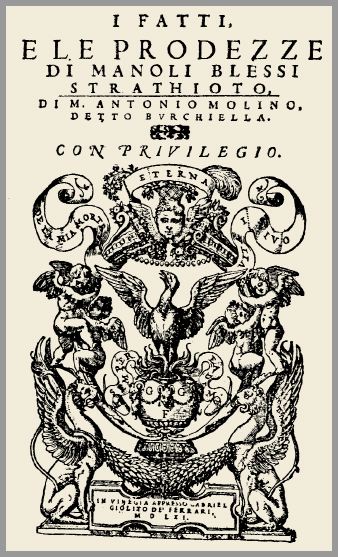
Manoli Blesi viti 1564
Manolis Blesis fitoi tituj të mëdha nga Këshilli të shërbimeve të mëdhe të ofruara për Republikën me vlera personale. Në arkivat veneciane ruhen armët e ushtarit legjendar, i cili dukej si një Hercules rinj.Arbërorët luftuan tre shekuj më parë për lirinë e Qipros me në krye arvanitin poet Manoli Blesi, që ky poet përmendë në poezitë e tij të gjithë arvanitët e tjerë që luftuan në rrethimin e Lefkosisë.
Njëra nga këto poema është shkruar në vitin 1571 nga poeti luftëtar, Manoli Blesi në gjuhën italiane, disa strofa të poemës, për herë të parë i gjejmë në librin e Kostandinos Biris "Arvanitasit Dorjenët dhe Grekët e rinj", dhe në librin "Arvanitët dhe prejardhja e grekëve" të autorit Aristidh Kola. Në vargjet e poemës, përmenden luftëtarët arvanitas që morën pjesë në luftë kundër turqve në Qipro. Poema e shkruar; në italisht nga arvanitasi Manol Blesi më 1571, ka mbi 41 strofa, por deri më sot nuk e kam gjetur të tërën, përveç strofave të botuara në librin e Kostandin Birit dhe Aristidh Kolës.:
O të varfër Luftëtarë...
si do t'ia bëjmë nga këtu dhe mot
të shkojmë me këmbë gjer në Qipro
të luftojmë tok
O të varfër Luftëtarë
4
Ku është tani Kelmendi madhështor
Kapedan i Ushtrisë
dhe ai i Gërbeshi burrëror
që i bëri turqit me u dridhë
bashkë me Gjinin e Frasqisë
Mbushur shpirt e fshehtësi...
5
Ku është Shtini dhe Kanaqi,
Meksi, Lopësi dhe Barbati
me Andruço mustaqelliun,
Petro Bua dhe Stamatë
që së bashku porsi Maçok
shkonin të gjithë në grackë;
O të varfër Luftëtarë...
41
Dhe hymë në dimër
do të rikthehemi në verë
me këtë shoqëri kaq të mirë
të Kalorësve dhe të Qitësve
trima dhe luftëtarë të zotë
siç bënin dhe me të vjetrit tanë
O të varfër Luftëtarë.....
Që nga viti 1560 ai luftoi në Dalmaci, në anën e venedikasve kundër turqve. Në 1570 ai mori pjesë në mbrojtjen e Nikozisë në Qipro gjatë rrethimit nga trupat e sulltanit. Dhe pastaj vetëm me katër ushtarë arriti në vendet e Danubit dhe kaloi në Austri ..

Code: Select all
Διάσημοι Ελληνοαλβανοί Στρατιώτες
Διάσημος ανάμεσα στους Ελληνοαλβανούς στρατιώτες προβάλλει ο Αναπλιώτης ευγενής Μανόλης Μπλέσης, που ανέβαζε την καταγωγή του στον άρχοντα Λέοντα Σγουρό. Ο Μπλέσης, εκτός από στρατιώτης, προβάλλει και ως ποιητής, η δε πολεμική δράση του σημειώνεται σε όλες σχεδόν τις μάχες ενάντια στους Τούρκους και σε εκστρατείες και επιδρομές που έγιναν στη Δυτική Ευρώπη.
Από τα 1560 πολέμησε στη Δαλματία στο πλευρό των Βενετών ενάντια στους Τούρκους. Στα 1570 πήρε μέρος στην άμυνα της Λευκωσίας της Κύπρου κατά την πολιορκία της από τα σουλτανικά στρατεύματα. Και στη συνέχεια με τέσσερις μόνο στρατιώτες έφτασε στις Παραδουνάβιες χώρες και διέσχισε την Αυστρία, τη Βαυαρία και την Πρωσία πάντοτε καβαλάρης και πολεμώντας.
Κατά τα μέσα του ιστ’ αι. η πολεμική δόξα και τα κατορθώματα του είχαν πλατιά απήχηση και τα τραγούδια του, που τα μελοποιούσαν Φλαμανδοί και Ιταλοί μουσικοί, ακούγο νταν στους δρόμους των ευρωπαϊκών χωρών και ιδιαίτερα στην Ιταλία.
Ο Μανόλης Μπλέσης τιμήθηκε με μεγάλους τίτλους από το Συμβούλιο των Δέκαγια τις μεγάλες υπηρεσίες που πρόσφερε στη Γαληνότατη Δημοκρατία και για την προσωπική αξία του. Στα βενετικά αρχεία διαφυλάχτηκε το οικόσημο του θρυλικού στρατιώτη, που φάνταζε ως ένας νέος Ηρακλής.
Μετά την επιστροφή του στη Βενετία έγραψε ποιήματα για την πολιορκία της Λευκω σίας, ελεγεία για τους διαλεχτούς στρατιώτες που έχασε εκεί. Η έκδοση έγινε στα 1571.
Η φήμη του Μανόλη Μπλέση και τα κατορθώματα του έπλασαν θρύλους γύρω από την ηρωική μορφή του. Ένας από τους θρύλους αυτούς αφορούσε στην αγάπη μιας Κρανιδιώτισσας μάγισσας προς τον Μπλέση, που για χάρη του είχε γίνει αερικό και τον ακολουθούσε παντού, τον προστάτευε από τους κινδύνους και τον όπλιζε με υπεράνθρωπη δύναμη, ώστε να βγαίνει νικητής από τις πολεμικές περιπέτειες του. Και θέλοντας να δοκιμάσει την αφο σίωση του, μεταμορφώθηκε σε δράκο και επανήλθε στην ανθρώπινη μορφή με ένα φίλημα του ήρωα, που τον αγκάλιασε και τον πήρε μαζί της στην αθανασία με εναέριο άρμα’”.“Nëse doni të zbuloni historinë para Krishtit dhe
shkencat e asaj kohe, duhet të studioni gjuhën shqipe !"
-----------------------------------------------------------------
Gottfried Wilhelm Leibniz - albanolog, matematicient, filozof gjerman
shkencat e asaj kohe, duhet të studioni gjuhën shqipe !"
-----------------------------------------------------------------
Gottfried Wilhelm Leibniz - albanolog, matematicient, filozof gjerman